A CRM that starts from your target, not last month’s report
Every CRM in this market tracks what already happened -- calls made, deals won, a dashboard for last month. A goal-oriented CRM works backwards instead: give it an outcome target and how your funnel actually converts, and it back-solves that into the number each person needs to do today, surfaced where the work happens.
No card. One module stays free forever when the trial ends.
- Call queue headersame number
- My worksame number
- Dashboard cardsame number
Recomputed from targets, ratios and the calendar every time it renders. Nothing is stored, so nothing can drift out of sync between screens.
Prescription, not monitoring
Goal TRACKING already exists everywhere -- attainment dashboards, activity feeds, a leaderboard. All of it looks backwards. A goal-oriented CRM runs the same loop every day, forwards from a target instead.
Ask
Four questions at setup: what kind of business, what the funnel looks like, what each person should hit, and what your believed conversion rates are -- entered as '1 in N' the way founders actually talk, not as percentages nobody trusts on day one.
Model
The four answers become a deterministic funnel for your org: stages, stage-to-stage ratios, working days. Nothing here is a guess about your business dressed up as software -- it is your own numbers, stored as your own numbers.
Prescribe
The target back-solves through the ratios into activity: how many calls (or whatever your first step is) each person needs today to stay on pace for the period. One pure function does the arithmetic, and it is unit-tested to the call.
Measure
Nothing new to log. Calls with outcomes, stage moves, invoices and payments already exist in the product -- the goal engine reads the same event stream every other screen reads.
Recalibrate
Believed ratios get replaced by observed ones as evidence accumulates -- visibly, with a sample size printed, and only when you approve it. Never silently.
The arithmetic, chained through one target
An illustration -- a consulting business, in round numbers, not a customer’s result. It is the same worked example on the Saahak landing page, and the same calculation every workspace runs on its own ratios: target, ratios and working days in, a daily number out.
100 calls -> 40 pick up -> 6 talk properly -> 2 become leads; 20 leads -> 1 client. One client costs 1,000 calls -- chained literally, that is what the ratios say, which is the point of showing the chain back before anything is prescribed.
A dashboard tells you on the 30th. That is the whole problem.
Every CRM in the Indian SMB market advertises real-time performance tracking. Tracking is not the same job as telling someone what to do before the month is already lost, and the difference shows up in exactly these ways.
It answers a question nobody asked in time
'What did we do last month' is answerable on the 1st. 'Are we going to make this month' needs an answer on the 5th, and a dashboard that only totals up actuals cannot say it -- there is nothing to compare the total to.
The shortfall has no owner and no day
A monthly number split five ways after the fact tells you the team missed by 40 calls. It does not say which of the five people needed to make 8 more calls on which of the 22 working days -- so nobody was ever actually behind, until everyone was.
Averages hide the one person who is actually behind
A team pace of 96% looks fine on a dashboard. It can be four reps at 110% covering for one rep at 40% -- the average never says who, and by the time someone notices, most of the month is gone.
Nothing tells you WHICH problem you have
Behind on outcomes could mean too few calls, or the right number of calls converting worse than believed -- and those are different Monday mornings. A totals dashboard cannot tell them apart; it was never built the question.
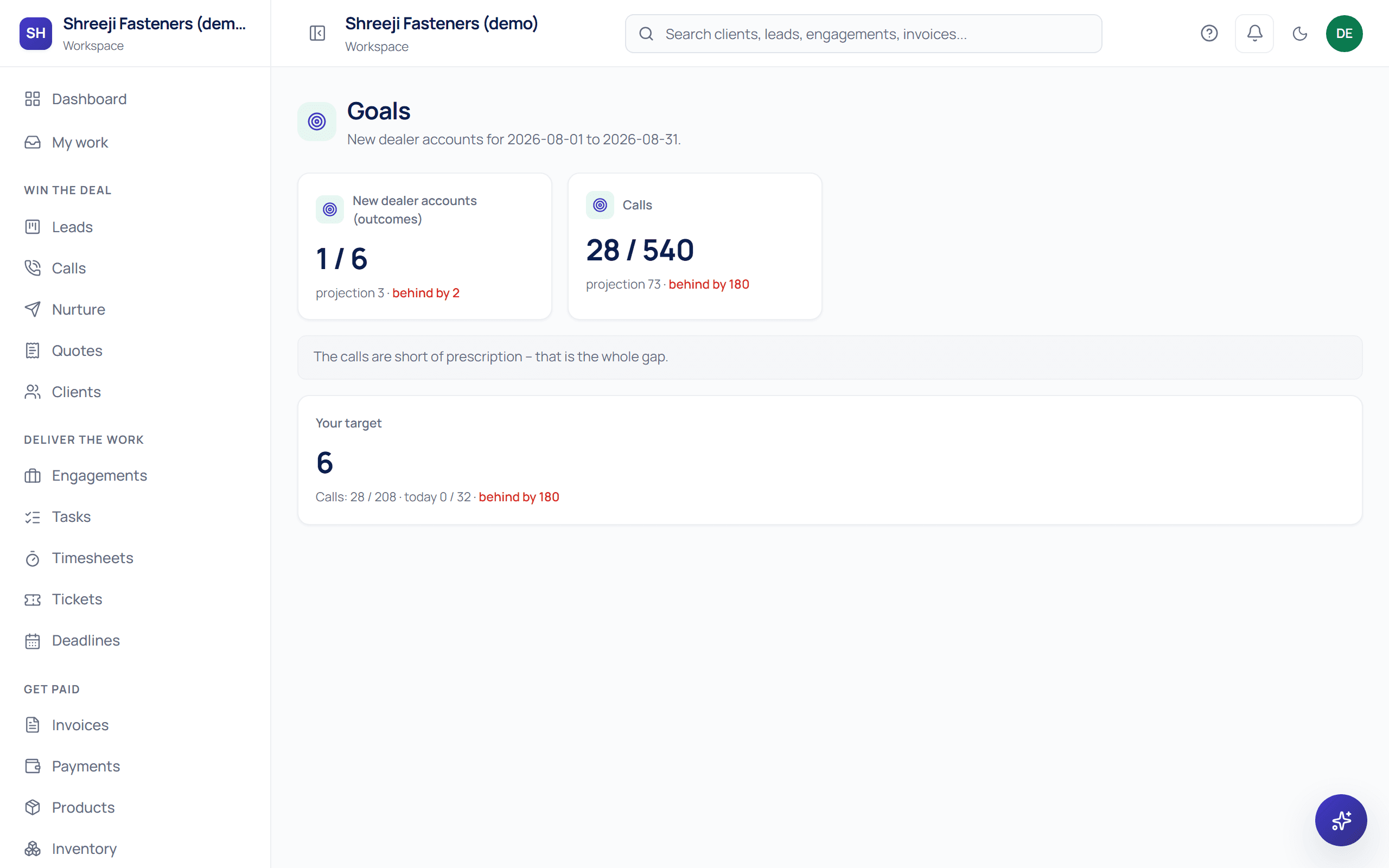
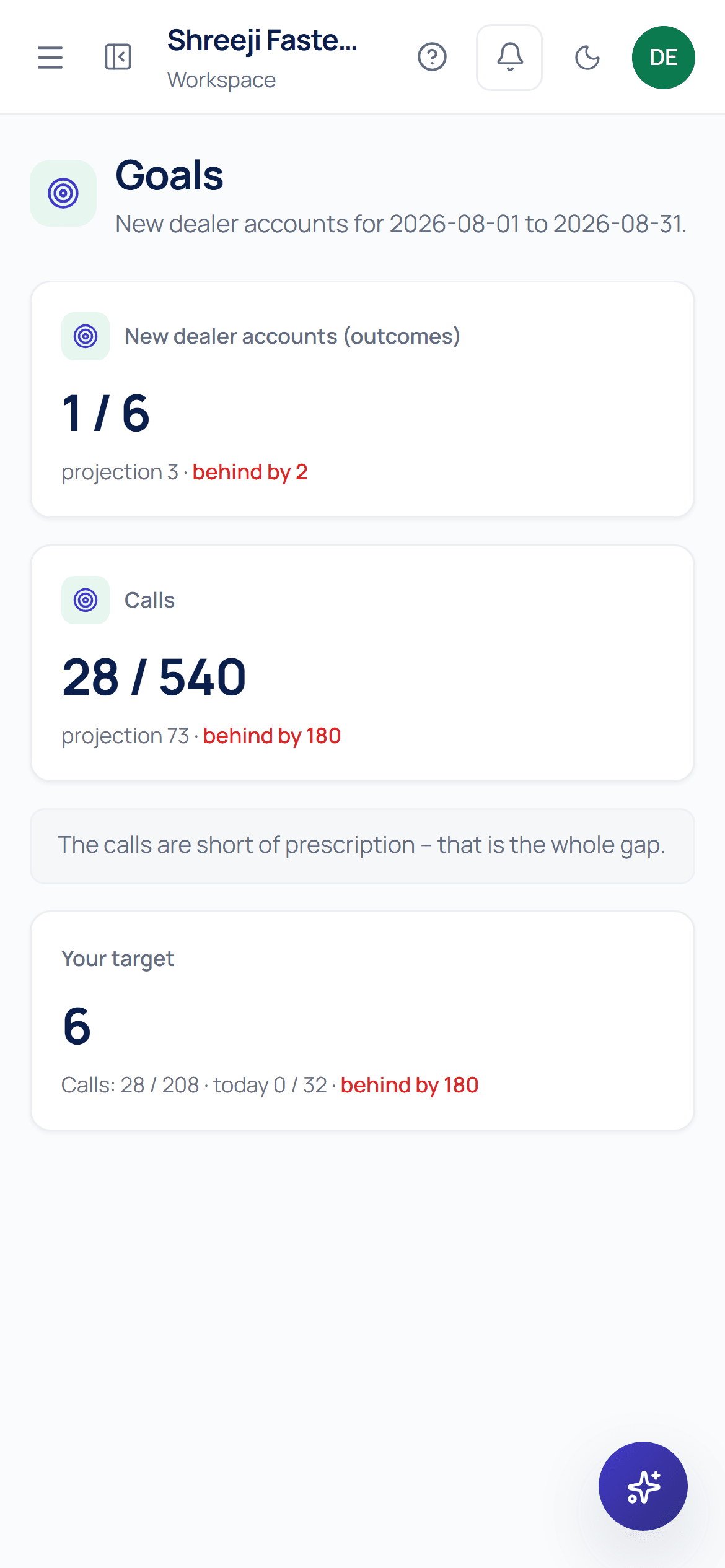
Saahak's answer is not a better dashboard -- it is the same derived number on the screens a rep and an owner already have open, with a reason attached when it is off. Live today at the call queue, My work, the dashboard card and /app/goals.
In 90 days, your targets run on your numbers, not your guesses
The believed ratios you enter on day one are a starting point, not a promise. As your own team logs real calls, Saahak has enough evidence to say something honest about how your funnel actually converts -- and only ever proposes acting on it, never applies it quietly.
The ratios are a guess on day one, on purpose
Nobody has real conversion data before they have made any calls. Saahak asks for your best belief, shows you the sanity mirror -- the implied chain, chained out loud -- and lets you correct it until it looks like your business, before anything is prescribed.
Small samples do not get to speak
Below 50 logged calls or 3 conversions on a step, Saahak says 'insufficient evidence', never a percentage. Two conversions from thirty calls is not 6.7% -- it is nothing yet, and the product says so instead of pretending otherwise.
Past 50 and 3, your own numbers start talking back
Observed ratios are computed from a rolling 90-day window of your own logged calls, shown side by side with what you believed, sample size printed on screen. This is the calibration panel, live on /app/goals today.
Adopting an observed ratio is a decision, not an update
The before-and-after daily number is shown before anything changes -- 'Team daily number: 8 to 4 calls', for example -- and the server re-derives the ratio and refuses a swing over 5% rather than trust a stale client number. Every change is versioned.
AI-powered where that earns its keep, and nowhere else
Ask the assistant why the team is behind, who needs help, or what a slower connect rate would do to the target -- it answers in plain language, citing the same figures the screens show. It never computes a number that reaches a screen; the deterministic engine does that, every time.
The privacy posture behind it“The assistant runs as you, and every number it says is computed by us, not by it.”
It reads only what your own login can read -- the same row-level rules as every screen, never a privileged path. A per-workspace switch turns it off instantly, and a deny-proof runs on every release: another organisation’s data, a teammate’s numbers you lack rights to see, and prompt-injection attempts all have to come back empty. The provider is named, with its data agreement linked rather than paraphrased.
Asked before the trial
What does 'goal-oriented' actually mean here?
Two different jobs get sold as one. Monitoring tells you what already happened -- calls made, deals won, a total for the month. Prescription tells you what to do today to hit a number you set -- back-solved through your own funnel ratios into an activity count per person per day. Saahak does the second one; most CRM 'goals' features do the first and call it done.
Where do the conversion ratios come from -- do I have to know them upfront?
You enter your best belief at setup, as '1 in N' per step. Saahak shows the implied chain back immediately (the sanity mirror) so an unrealistic guess is visible before it prescribes anything. After 90 days of your own logged calls, Saahak proposes replacing believed ratios with observed ones, sample size shown, and only with your approval.
Does the AI assistant decide my numbers?
No. The assistant answers questions in plain language -- why are we behind, who needs help, what happens to the target if a rate changes -- but every figure it states comes from the same deterministic engine every screen uses; it narrates, it never calculates. It runs under your own login with the same row-level access as any screen, has a per-workspace off switch, and the provider is named with its data agreement at /security.
Is this a roadmap item, or is it running today?
It is live. The call queue header, My work and the dashboard card all carry the same derived today's-number; the owner pace view with the reason for a shortfall lives at /app/goals; the calibration panel with observed-vs-believed ratios is on the same page; the assistant answers goal questions from those figures.
Does this replace my dashboards, or sit next to them?
Next to them. The leaderboard still shows actuals, now with target and pace columns beside them; the owner's morning digest still summarises yesterday, now with one added line for where the period stands. What changes is that every surface a rep or owner already opens carries the day's number too, instead of only a retrospective.
The goal engine surfaces where reps already work. See how the call queue itself runs, or how a business like yours would set its targets.
Give your team today's number tomorrow morning
Set your target and ratios in the interview. 14-day trial, then a 12-month commitment.