How many calls does it take to win a client? The funnel math Indian sales teams skip
7 Aug 2026 · The Saahak team · 4 min read
Most sales targets are a hope wearing a number's clothes. "10 clients this quarter" gets written on a whiteboard, everyone nods, and then Monday morning arrives and nobody's day looks any different than it did before the target existed. The number sits at the wrong altitude -- it describes an outcome three months out, and a rep needs to know what to do in the next hour.
The fix is not a better dashboard. It's arithmetic most sales teams already have the ingredients for and never actually run: a back-solve, where you take the outcome you want and divide it, step by step, backward through your own funnel, until you land on an activity count for today. This is the exact calculation we built into Saahak's goal engine, and it's short enough to do on paper, so here it is worked through in full.
Say it as "1 in N", not as a percentage
Founders and sales managers do not talk in conversion percentages. Nobody says "our pickup rate is 40%" out loud in a Monday meeting -- they say "about 1 in 2.5 calls actually gets picked up." That phrasing is not a quirk, it's more honest: a percentage implies precision you don't have yet, while "1 in N" is plainly an estimate you're prepared to be wrong about and correct later. Every stage of a funnel can be stated this way, and chained together, the whole thing becomes one multiplication.
The chain, worked through
Take an illustrative consulting business -- round numbers, not a customer's result, redo this with your own funnel and it will look different. Four stages, each stated as a ratio:
Calls to pickups: 1 in 2.5 -- a rep dials, 2 out of every 5 calls get answered
Pickups to real conversations: 1 in 6.67 -- most pickups are a fast no, not everyone who answers actually talks
Conversations to leads: 1 in 3 -- a real conversation sometimes turns into genuine interest
Leads to clients: 1 in 20 -- most interested people do not become a client, and that is normal
Chain those four ratios together -- 2.5 x 6.67 x 3 x 20 -- and one client costs 1,000 calls.
That number tends to land wrong the first time someone sees it. It feels too high. It usually isn't -- it's what the funnel actually says once you stop rounding generously at every step. Run the chain the other direction and it explains itself: 1,000 calls imply 400 pickups, 400 pickups imply 60 real conversations, 60 conversations imply 20 leads, and 20 leads imply exactly the 1 client you started with. Nothing invented, nothing dropped -- the same four ratios, read forward.
From a monthly target to a daily number
Say the target is 5 clients this month. At 1,000 calls per client, that's 5,000 calls. Spread over 26 working days, that is roughly 192 calls a day across the whole team. One rep making 150 calls a day produces about 3 leads a day and closes a client roughly every 7 working days on their own -- so a 5-client month at that pace needs about 1.3 reps. You cannot hire 1.3 people, obviously, but the honest fraction still matters: it's the difference between staffing 2 reps who are comfortably ahead of pace and staffing 1 rep who is quietly quarter behind by the third week and nobody notices until the monthly number comes in short.
This is also why a monthly total is the wrong unit to manage against day to day. "192 calls a day" is not fixed once and forgotten -- it has to be recalculated from whatever is left of the target and whatever is left of the month. A rep who logged nothing on Monday owes more on Tuesday, spread over the working days that remain, not the working days that started the month. A rep who is already ahead is never told to make a negative number of calls -- the floor is zero, and an off-day prescribes zero too. The number the rep sees each morning is always "what do I owe today," never "what did the plan originally say."
One honest aside from actually building this: an early draft of a similar chain, for a different kind of business entirely, implied 15,000 calls to close a single deal. Nobody would ever act on a number like that -- it's not a target, it's a sign that one of the ratios in the chain is wrong, or that the funnel has more stages than the four being tracked. That's exactly why the back-solve has to show its chain back to you before you commit to it, rather than silently handing you a daily number and trusting the ratios that produced it.
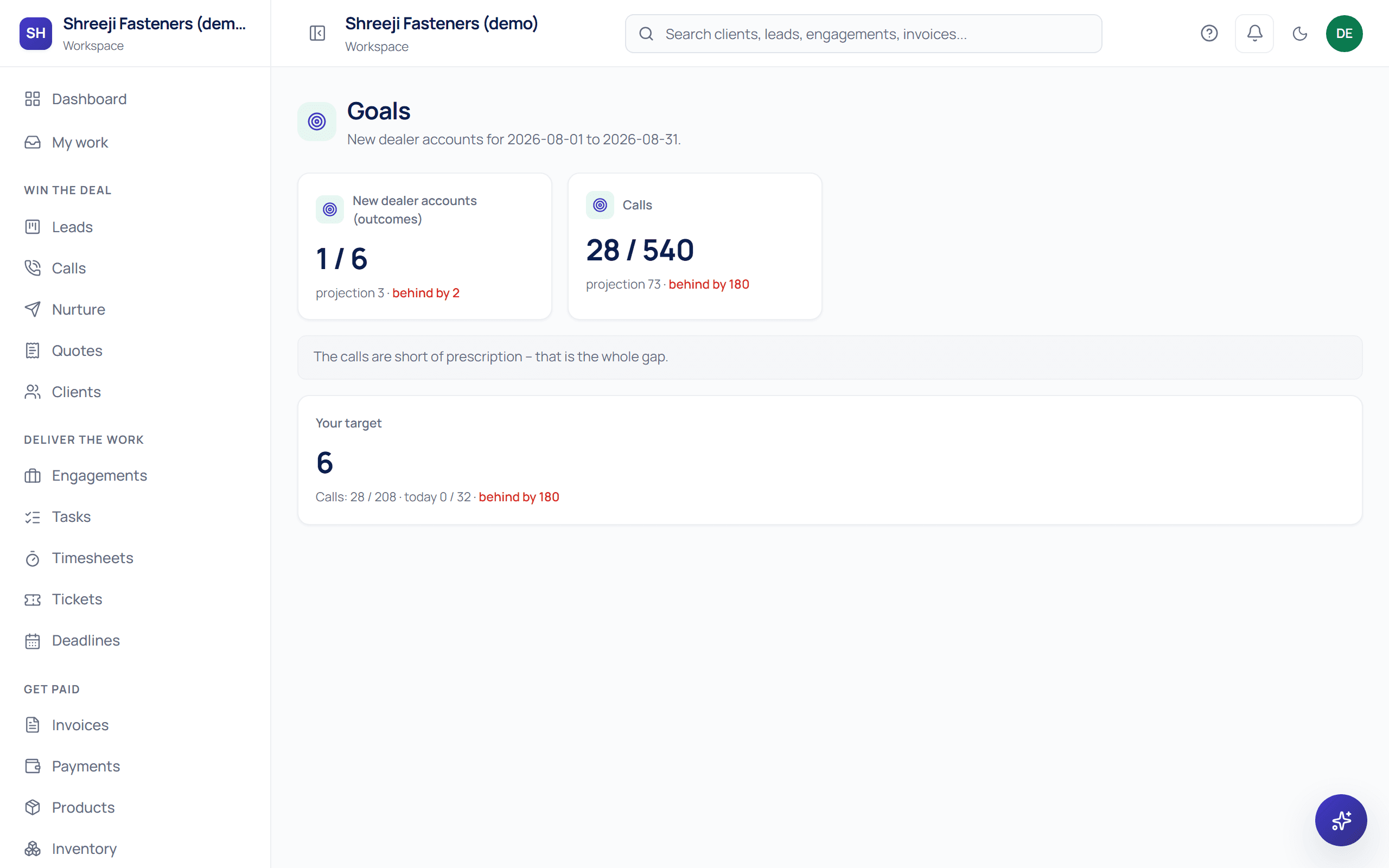
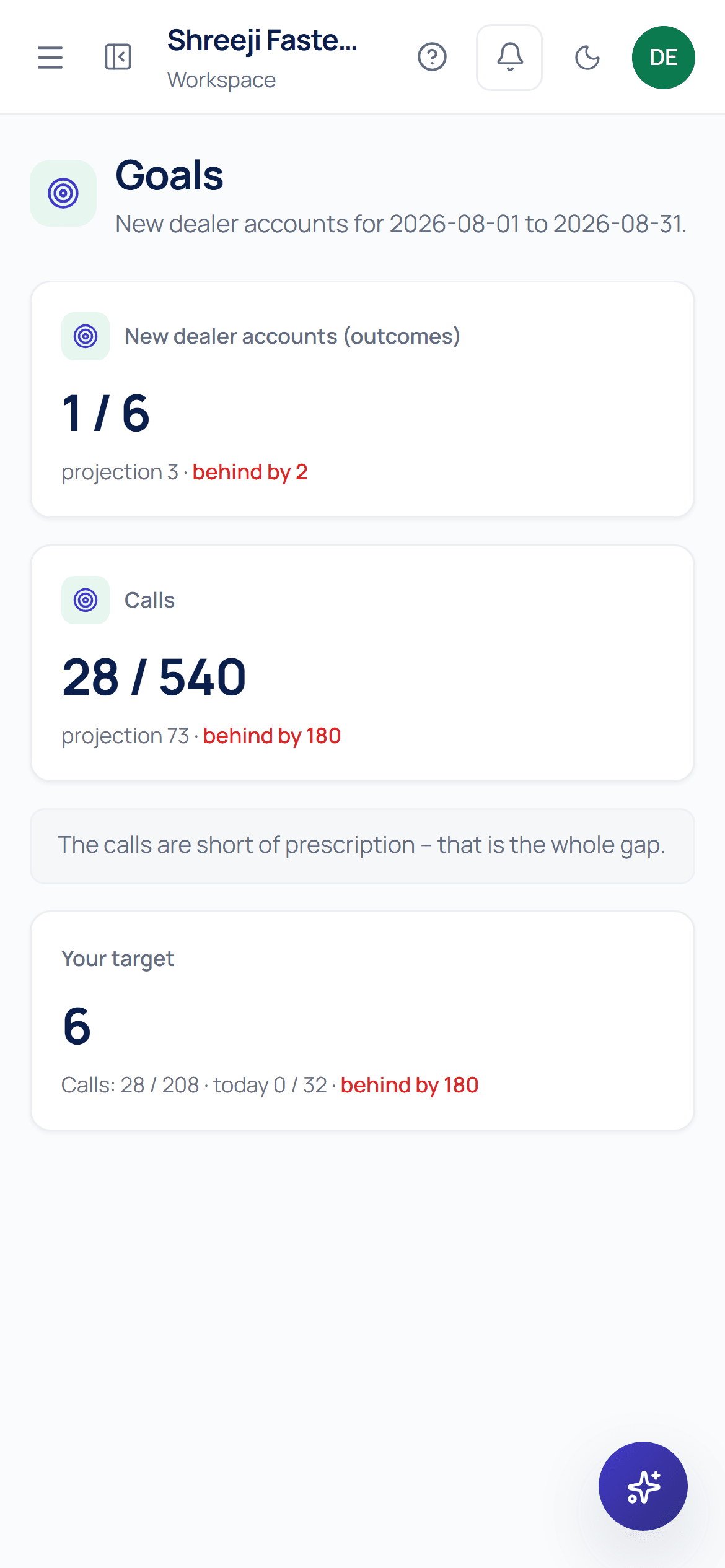
This is the arithmetic behind Saahak's goal engine, running today on live targets, not a spreadsheet template. See how the back-solve runs end to end
You do not need software to run this once. Pull your last 100 calls, count how many were picked up, count how many turned into a real conversation, count how many of those became a client. Chain the ratios, and you will have a number that is either uncomfortably higher than what your team is doing today, or reassuringly close to it. Either way, it is a number you can defend on a Monday, which a target on a whiteboard never was.