GST invoices from a CRM: the CGST/SGST split, credit notes, and the Tally handoff
7 Aug 2026 · The Saahak team · 3 min read
A lot of small Indian businesses invoice out of Word or Excel for longer than they'd admit, and the GST split is usually the first place it goes wrong -- not because the arithmetic is hard, but because it depends on a fact that is easy to get wrong by hand: whose state is whose. Get that one fact right and the rest of GST invoicing is mechanical. Get it wrong and every invoice built on top of it needs correcting at filing time.
Why CGST plus SGST versus IGST is not a choice
The rule is fixed by law, not a preference: if the seller's registered state matches the buyer's state, the tax splits into CGST and SGST, each at half the GST rate. If the two states differ, the whole rate is charged as IGST instead. There is no third option and no discretion in the middle. Saahak reads the issuer's state from the business's own registered profile and the buyer's state from the client record, and it will not let an invoice be created as a GST invoice at all until both are actually on file -- because a GST invoice with an unresolved state is not a smaller mistake, it is the exact mistake this rule exists to prevent.
A credit note is the same math, run backward
Goods get returned, orders get partially cancelled, an invoice goes out overcharged -- a credit note exists for exactly that, and it has to reverse everything the original invoice did. What the client owed goes down by the credited amount, the sales revenue that invoice recorded goes down to match, and the GST liability drops by the same CGST, SGST or IGST split the original invoice carried, not a re-derived one. Every credit note references the invoice it corrects, so "why did this client's balance change" is always answerable by looking at one linked document, not by reconstructing it from memory. It also carries its own draft, issued and void states, and issuing one requires the same approval permission as approving an invoice -- a credit note is real money moving on paper, and it does not get created silently.
Where the books actually have to balance
Underneath the invoice sits a double-entry ledger, and double-entry has exactly one rule that is non-negotiable: every entry's debits and credits must sum to zero, or it gets refused. An invoice debits the client for the full amount and credits Sales plus whichever GST accounts apply; a credit note is the literal mirror -- the client is credited, Sales and the GST accounts are debited. Post a fully-credited invoice alongside the credit note that reverses it and the two cancel out to nothing, which is exactly what should happen to a sale that never actually completed.
Handing it to your accountant
None of that is useful to an accountant sitting in Tally unless it gets there in a shape Tally understands. Saahak builds a one-way XML export -- a Sales voucher for every issued invoice, a Receipt voucher for every recorded payment, a Credit Note voucher for every issued credit note -- written to the exact convention Tally's own importer expects: debit lines carry a negative amount and are marked ISDEEMEDPOSITIVE Yes, credit lines carry a positive amount and are marked No. Your accountant opens Tally, goes to Import Data under Vouchers, and points it at the file.
Said plainly, because the difference matters: this is an export, not a sync. There is no live connection to Tally and no background reconciliation -- your accountant runs the import when they are ready, on their own schedule, and the file covers the sales side of the business: invoices, payments received against them, and credit notes. It is a real handoff that saves a week of manual entry at month end, and it is honestly scoped rather than oversold as more than that.
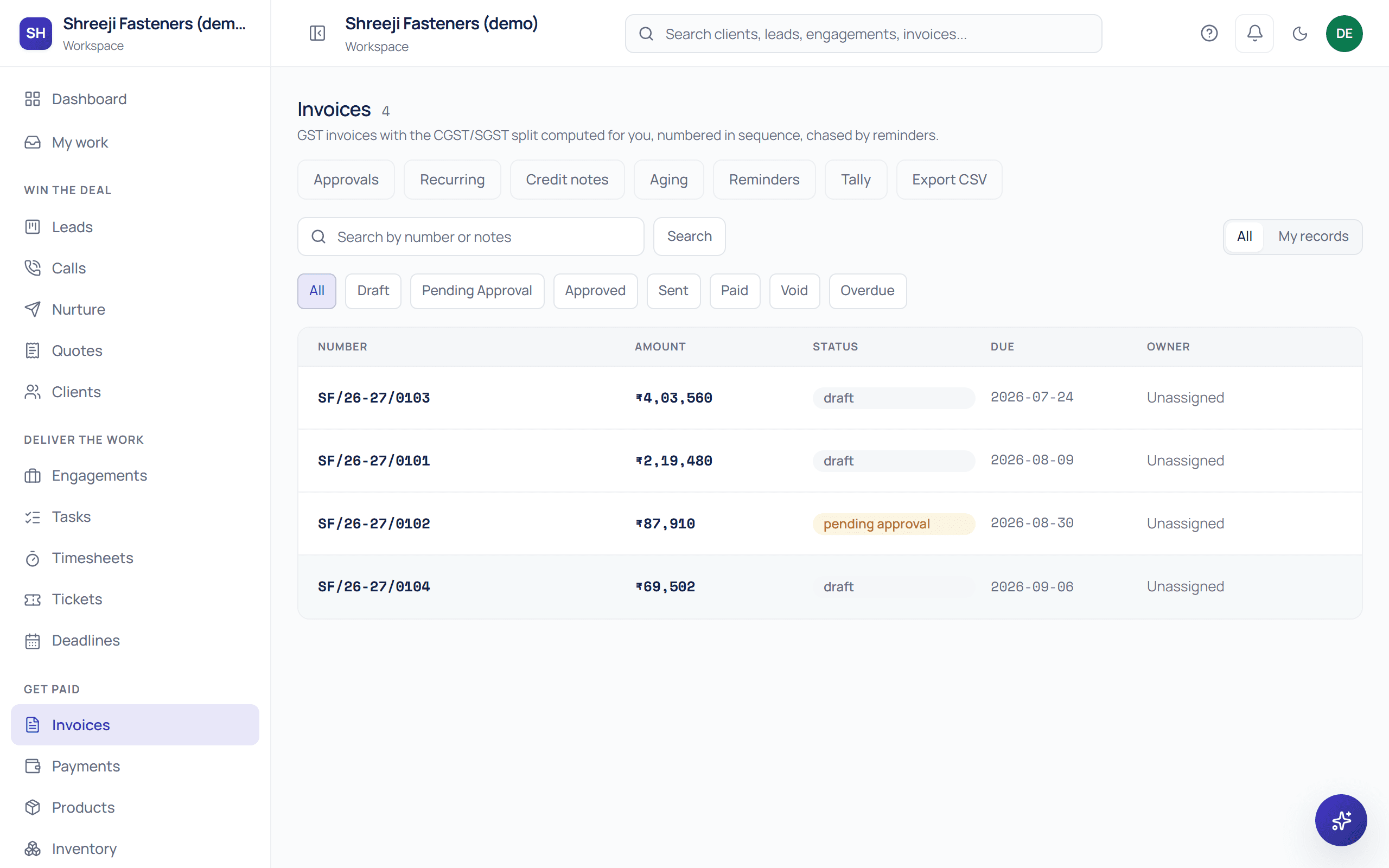
This is the invoicing and stock machinery a manufacturer or trader actually runs day to day. See the fuller walkthrough for traders and manufacturers
GST invoicing is not the interesting part of running a business. That is exactly why it is worth getting the boring part right the first time -- the state check that stops a wrong split before it happens, a credit note that cannot silently forget the tax it is reversing, and a books entry that refuses to exist unless it actually balances.