WhatsApp for sales teams: the official API vs the sync apps that get numbers banned
7 Aug 2026 · The Saahak team · 4 min read
Every sales team that runs on WhatsApp eventually asks the same question: can we get all our chats into one screen, so a manager can see what every rep is saying without shoulder-surfing five different phones. The answer that gets sold most often is a sync tool -- something that logs into WhatsApp Web on the rep's phone, or runs an automated session in the background, and pipes the messages into a dashboard. It looks like exactly what was asked for. It is also the single most common way an Indian small business loses the number its customers actually trust.
Why the convenient version breaks
WhatsApp Web sync tools work by pretending to be a phone. There is no approved way to programmatically drive a personal WhatsApp session at scale -- the mechanism is reverse-engineered, it sits outside WhatsApp's terms of service, and Meta's abuse detection is built to catch exactly this pattern. A number that has spent two years building trust with customers can be banned in an afternoon, with no appeal that reliably works, because the account was never meant to be automated in the first place. This is not a rare edge case. It is the most-reported failure mode of the whole category.
What official actually means
The alternative is WhatsApp's own Business Platform, sometimes called the Cloud API. A business connects its own WhatsApp Business number through Meta's Embedded Signup flow, and every message after that genuinely goes through Meta's own infrastructure. That distinction is not marketing language -- it is the reason delivery states can be trusted at all. "Delivered" and "read" are not inferred from a script watching a screen; they arrive as webhook events straight from Meta, which is the only source honest enough to report a failed send as failed rather than quietly hiding it.
What it costs, stated plainly
Meta prices messages by category, and the rates are Meta's, set by Meta, not marked up by whoever built the CRM sitting on top of the API. As of mid-2026, a marketing template message runs about Rs 0.8631, a utility template (an order update, an appointment reminder) runs closer to Rs 0.115, and replies inside the 24-hour service window -- a customer messaging the business first, or replying to something the business sent -- cost nothing at all. A business that gets customers replying inside that window, rather than sending cold broadcast after cold broadcast, spends a fraction of what the sticker price on a marketing message suggests.
The architecture question that actually matters for a small business is whose billing the message runs against. Built correctly, the tenant connects their own WhatsApp Business Account and their own Meta payment method -- the software in the middle never touches the message money, and never marks it up. A business paying Rs 0.8631 a message is paying Meta Rs 0.8631 a message, full stop.
The path that costs nothing at all: wa.me
Not every team is ready to connect a Business Account through Meta's review process on day one, and that is a real constraint, not a shortcoming. The zero-setup path is a wa.me link: tap a button, WhatsApp opens on the rep's own phone with the message already typed, and the rep presses send themselves. Nothing routes through an API, so there is no per-message fee -- it is, mechanically, the same as a rep opening WhatsApp and typing the message by hand, just faster to get to that point. The honest limits: no delivery receipts beyond "the link was opened," no bulk sending, and it depends on the rep's own number rather than a shared business one. It is a real path, not a lesser demo of the real thing, and plenty of small teams run their whole outbound WhatsApp motion on it.
The feature everyone asks for is the one to be most careful about
If a CRM vendor offers to automatically pull in every existing WhatsApp conversation without anyone reconnecting anything, ask exactly how. There are only two honest answers: it runs through the official API, in which case new conversations start clean because history does not transfer through Meta's own platform either, or it runs through an unofficial session, in which case the number is one policy sweep away from being unusable. There is no third option where an unofficial sync is both comprehensive and safe -- that combination does not exist, and any pitch implying otherwise is describing the failure mode, not a feature.
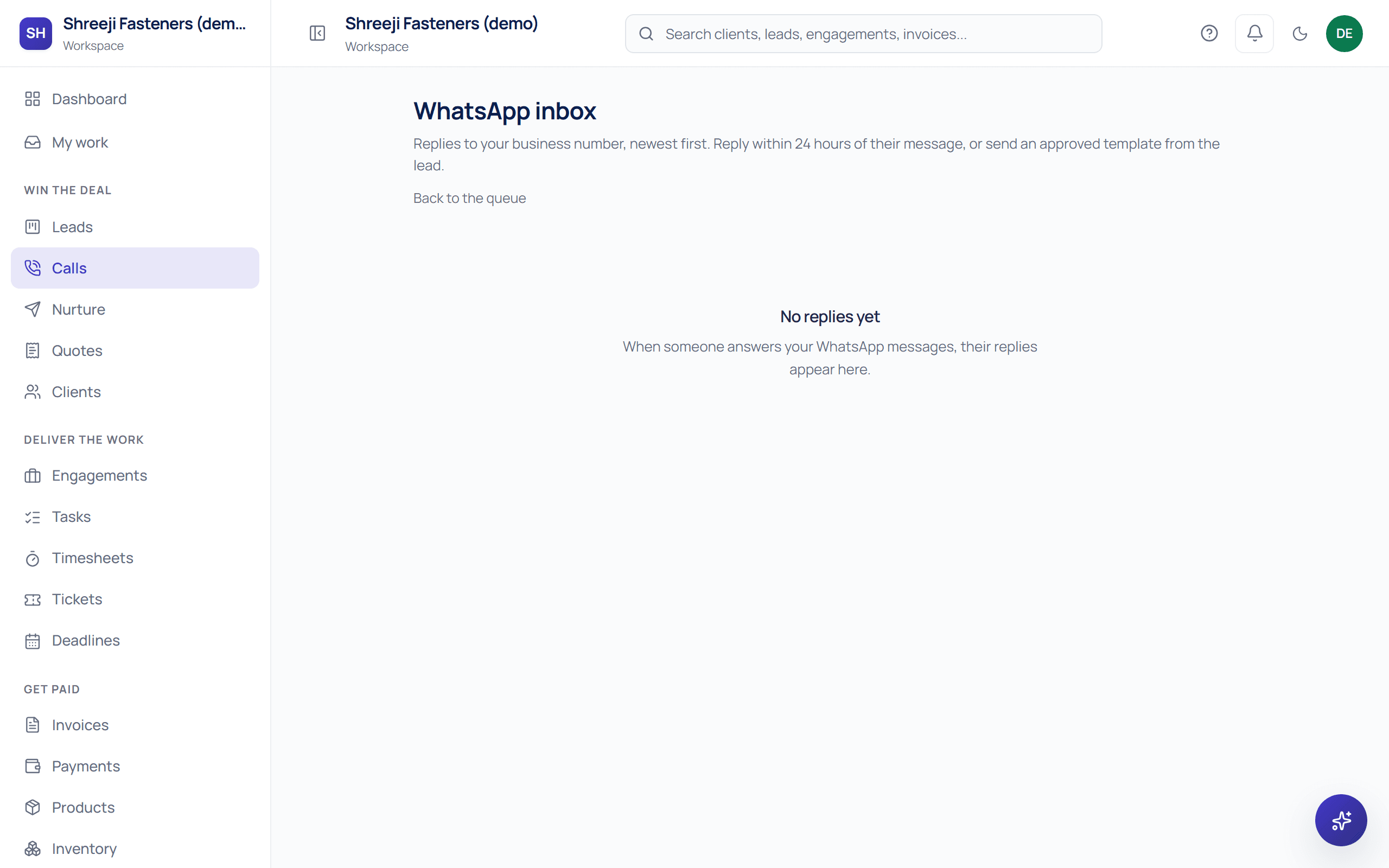
This is why Saahak builds only two paths: the official Cloud API (currently moving through Meta's own review process) and the wa.me link, live today. See the call-and-WhatsApp queue this runs inside
Neither path is dramatic. One costs Meta's own published rate and reports honestly. The other costs nothing and asks a rep to press send themselves. What both have in common is that the business's number is still theirs at the end of the quarter -- which is worth more than the convenience a sync tool is selling.